


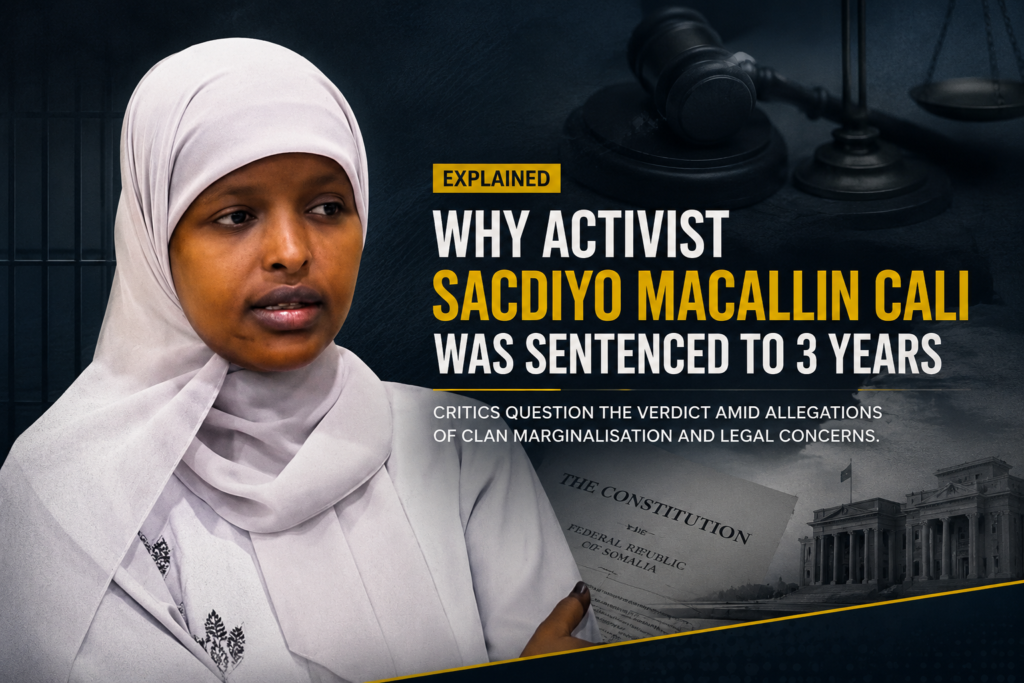
MOGADISHU (GG) — The three-year prison sentence handed down to social media activist and tuk-tuk driver Sacdiyo Macallin Cali has ignited a fierce national debate regarding its constitutionality, alongside mounting allegations of clan-based marginalisation within Somalia’s judicial system.
Legal analysts and opposition lawmakers have formally questioned the legality of the Banadir Regional Court verdict. The defense team argues that the court’s application of Article 269 of the archaic 1962 Somali Penal Code—which criminalizes insults against public officials—directly violates Article 18 of the Provisional Constitution of Somalia, which explicitly guarantees freedom of expression and opinion for all citizens.
Public frustration has further intensified due to social media reports and community statements identifying Cali as a member of the Biyomal clan, a minority group historically marginalized within national power structures. Critics and local elders accuse the political administration of selectively prosecuting a vulnerable working-class woman from a small clan, arguing that individuals from major tribal blocks who make similar or harsher critiques against President Hassan Sheikh Mohamud rarely face matching criminal sentences.
While the United Nations has not issued an independent, isolated diplomatic statement regarding Cali’s sentence, international human rights monitors operating under global frameworks have intervened. The Coalition of Women Human Rights Defenders in Somalia and Amnesty International have documented the case, condemning the detention as politically motivated and calling for her immediate release on the grounds of international free-speech treaties ratified by the Somali state.
The state prosecution maintains that Cali’s digital broadcasts crossed the threshold of lawful dissent by attempting to incite public unrest and undermine the security of the capital.
The defense council has filed a formal petition to escalate the matter to the appellate court, where the constitutional conflict between the old penal codes and civil liberties will be re-examined.