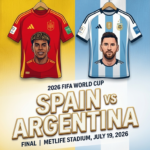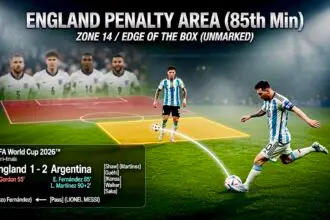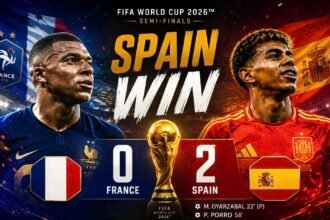


EAST RUTHERFORD (Sports Desk) — FIFA officials have strongly rejected suggestions that the decision to award the 2026 World Cup Golden Ball to Spain’s midfielder Rodri was an intentional move to deflect accusations of favoring Argentina and Lionel Messi. The individual accolade, presented following Spain’s 1-0 extra-time final victory at the New York New Jersey Stadium, was decided strictly on technical performance metrics compiled throughout the 39-day tournament.
According to an official statement by FIFA, the individual awards are determined independently by the organization’s Technical Study Group, consisting of veteran managers and tactical analysts. Critics had previously raised concerns over potential bias after a series of contentious refereeing decisions during the knockout rounds, including an incident where Messi avoided a red card against Algeria, and a formal officiating complaint submitted by Egypt. However, the governing body emphasized that the Golden Ball selection remains entirely insulated from external public relations considerations.
The structural separation between FIFA’s tournament accolades and the Ballon d’Or further complicates any theory of administrative deflection. The Ballon d’Or is organized, managed, and awarded entirely by the French publication France Football, utilizing a distinct voting block composed of 100 international journalists. While Rodri won the Ballon d’Or in 2024, the 2026 power rankings published by Vanguard News indicate that Spain’s Lamine Yamal and Lionel Messi remain the mathematical favorites for this year’s prize following the conclusion of the tournament.
Comparative World Cup Performance Analysis
Tactical Influence and Positional Volume
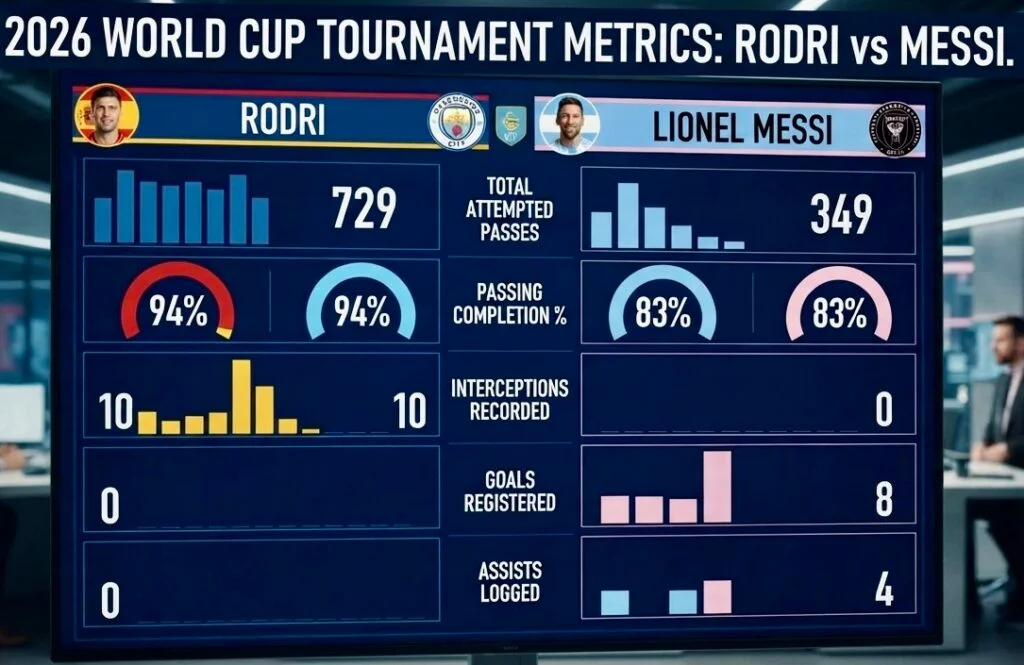
A deep statistical analysis explains why the Technical Study Group favored the Spanish captain over his Argentine counterpart. According to tracking data published by Manchester City, Rodri dominated the tournament’s distribution metrics, finishing first overall in total touches (712), total attempted passes (729), and completed passes (692). Operating as a single pivot, he anchored a Spanish side that registered seven clean sheets across eight matches.
Conversely, Lionel Messi operated in a highly specialized, low-volume playmaking role for Argentina. Data compiled by YEN Sports shows that while Messi accumulated far fewer total touches and a lower passing completion rate (83%) than Rodri (94%), his positional gravity remained the focal engine of Argentina’s offensive phase, drawing multiple defensive markers to open central passing lanes for teammates.
Offensive Output and Final Executions
The primary divergence between the two finalists rests on direct offensive volume. Messi finished the tournament with eight goals and four assists, placing second in the Golden Boot race behind France’s Kylian Mbappé. His attacking efficiency was instrumental in navigating knockout fixtures against England and Switzerland.
Rodri failed to register a single goal or assist during his 726 minutes on the pitch. However, the Technical Study Group heavily weighted his ability to break opposing lines, where he ranked first overall in line-breaking passes and second in final-third completions.
The Decisive Head-to-Head Impact
The statistical disparity became definitive during Sunday’s final match. According to ESPN Soccer, Rodri completely choked off Argentina’s central transitions, restricting Scaloni’s squad to zero total shots on target during the 120 minutes of play.
Messi was kept completely quiet, failing to record a single shot, goal, or assist for the first time in 12 consecutive World Cup appearances. This structural containment allowed Spain to control 68 percent of the possession, providing the definitive technical justification for Rodri’s Golden Ball selection over the Argentine captain.
Was Rodri really deserved?
The question of whether Rodri deserved the 2026 World Cup Golden Ball over Lionel Messi or Kylian Mbappé depends entirely on which footballing philosophy is prioritized: absolute structural control or decisive offensive volume.
An examination of the data compiled by tournament analysts and sports networks highlights the core arguments for and against his selection.
The Case For Rodri: Unprecedented Positional Dominance
The technical decision by FIFA’s Technical Study Group to award the tournament’s highest individual honor to the Spanish captain is rooted in metrics that quantify game control rather than box-score output:
- Passing Volume and Efficiency: According to tracking data from Manchester City, Rodri operated as the undisputed engine of the world champions, completing 692 of 729 attempted passes. His 94% completion rate is the highest ever recorded by a starting midfielder in an eight-game World Cup campaign.
- Line-Breaking Transitions: While he did not register a goal or an assist, The Athletic FC reports that Rodri led all players in “progressive line-breaking passes” (84). He routinely bypassed opposing midfields, supplying Lamine Yamal and Nico Williams with immediate isolation opportunities out wide.
- Defensive Rest-Shape: Operating as a single pivot, Rodri anchored a Spanish side that conceded only one goal from open play all tournament. His defensive positioning protected center-backs Pau Cubarsí and Aymeric Laporte, allowing Spain to maintain a historically high defensive line.
The Case Against Rodri: The Lack of Final-Third Execution
Critics of the decision point to the historic precedent of the Golden Ball, which has traditionally been awarded to the tournament’s most explosive, box-office attackers. The primary arguments against his selection include:
- Zero Direct Goal Involvements: Rodri completed the tournament with zero goals and zero assists. Skeptics argue that an award celebrating the “Best Player” should feature someone who directly turned the scoreline in high-pressure moments.
- The Volumetric Impact of Messi and Mbappé: Lionel Messi finished the tournament with eight goals and four assists, single-handedly carrying a heavily fatigued Argentine side through consecutive extra-time matches against Switzerland and England. Kylian Mbappé secured the Golden Boot, delivering high-volume scoring numbers despite France’s semifinal exit.
- System vs. Individual: A prominent argument among journalists is that Rodri benefited immensely from playing within Luis de la Fuente’s flawless, synchronized system. In contrast, Messi was forced to manufacture goals out of completely sterile possession phases for Argentina.
The Defining Metric: The Head-to-Head Final
Ultimately, the Technical Study Group’s decision was solidified during the 120 minutes of the final match at MetLife Stadium.
As recorded by ESPN Soccer, Rodri completely choked off Argentina’s central transitions. His defensive containment restricted Lionel Scaloni’s squad to zero total shots on target during regulation time. By keeping Messi completely quiet—marking the first time in 12 consecutive World Cup appearances that the Argentine captain failed to record a shot or a key pass—Rodri provided the definitive, on-field justification to claim the trophy.