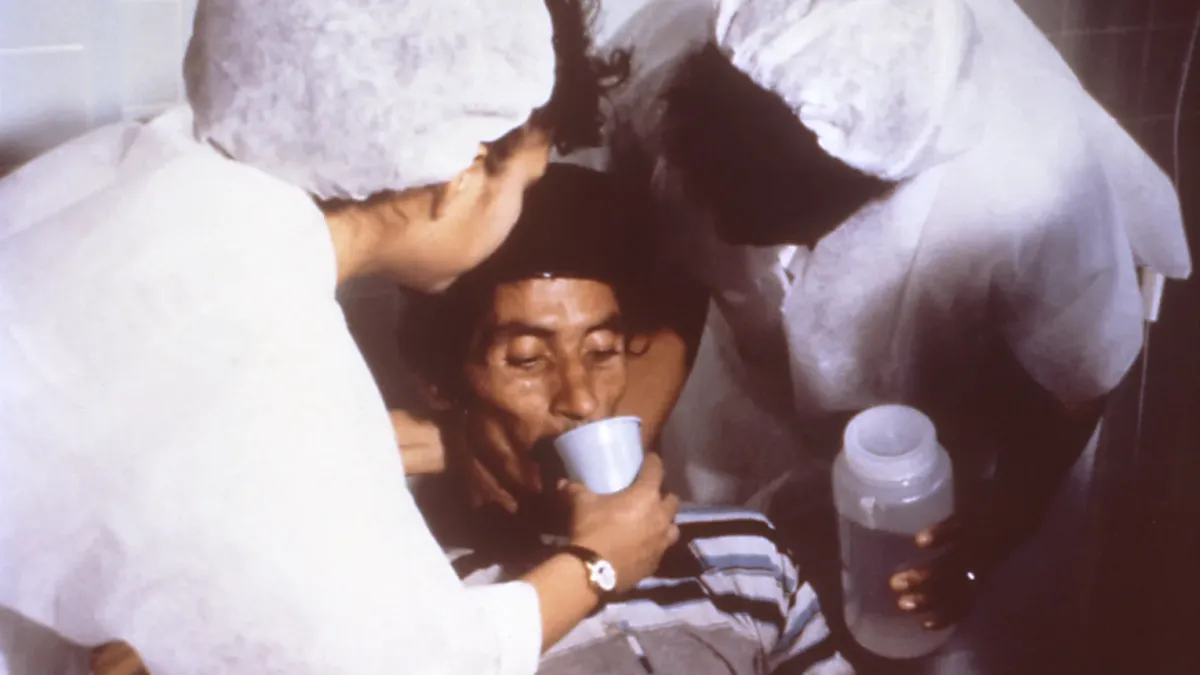
How to make oral rehydration solution safely: dissolve one ORS sachet in safe water exactly as the packet instructs, then give it in small, steady sips. The WHO identifies dehydration as the main danger of diarrhoea, and ORS is the main treatment. A child or adult who cannot drink, is very drowsy, or has blood in the stool needs a health facility, not home care.
Key takeaways
- Follow your sachet packet for the amount of water to mix.
- Keep breastfeeding and keep feeding usual food while giving ORS.
- If vomiting starts, pause for about 10 minutes, then give a spoonful every 2 to 3 minutes.
- A home mix of sugar and salt is a fallback only, because mistakes in making it can be serious.
- Go to the nearest health facility fast if the person is lethargic, cannot drink, or has bloody diarrhoea.
What ORS does and why it matters
The WHO defines diarrhoea as three or more loose or liquid stools in a day. It describes ORS as a solution of clean water, sugar and salt that costs a few cents per treatment. The body loses water and salts through watery stools, and ORS replaces them. The WHO estimates that diarrhoea kills about 443,832 children under 5 and 50,851 children aged 5 to 9 each year.
How to make oral rehydration solution from a sachet
The WHO says one sachet goes into 1 litre of safe water. Sachet sizes vary between brands, so the packet is the final word.
- Wash your hands with soap and water.
- Use boiled, treated or bottled water, which is the advice in the CDC Yellow Book for adding the packet.
- Read the packet and measure the amount of water it names.
- Pour in the powder and stir until it dissolves.
- Give the solution in small, frequent sips. For children under 2, the MSF guideline based on the WHO plan says a teaspoon every 1 to 2 minutes, and not from a baby bottle.
- Keep giving ORS alongside usual food, according to the CDC.
How much to give a child after each loose stool
The amounts below are for a child with no dehydration who is being treated at home (WHO Plan A, as set out in the MSF Medical Guidelines). They are given by body weight after each loose stool.
| Child’s weight | ORS after each loose stool |
|---|---|
| Under 5 kg | 50 mL |
| 5 kg to under 10 kg | 100 mL |
| 10 to 20 kg | 200 mL |
| Over 20 kg | 300 mL |
What to do if the child vomits
The MSF guideline says to wait about 10 minutes, then restart with a spoonful every 2 to 3 minutes. If vomiting keeps fluids from staying down, the NHS lists that as a reason to seek urgent help.
Home fallback: sugar and salt mix
Use this only when no sachet is available. The WHO cholera Q&A gives the homemade version as:
- 1 litre of safe water
- 6 teaspoons of sugar
- Half a teaspoon of salt
The CDC warns that family-made solutions carry a risk of serious errors, so packaged sachets are preferred. Measure the spoons carefully and use safe water.
How to judge dehydration: severity table
The table below follows the WHO classification as reproduced in the MSF Medical Guidelines. The guideline classifies a person by two or more signs in a column.
| Level | Signs | What to do |
|---|---|---|
| No dehydration | Normal mental state and eyes, skin pinch returns in under 1 second, not thirsty, normal urine | Give ORS and food at home, and watch for return signs |
| Some dehydration | Restless or irritable, sunken eyes, skin pinch goes back slowly, thirsty and drinks eagerly, less urine | ORS over 4 hours (75 mL/kg in the WHO plan) |
| Severe dehydration | Lethargic or unconscious, sunken eyes, skin pinch goes back very slowly (over 2 seconds), cannot drink or drinks poorly, no urine for several hours | Emergency. IV fluids at a health facility |
The NHS adds simpler signs to watch: dark, smelly urine or peeing less than usual, and fewer wet nappies in children under 5. The CDC also lists a sunken soft spot (fontanelle) in infants, dry mucous membranes and cool hands and feet as signs of moderate to severe dehydration.
Go to a health facility now if
- The person is lethargic, unconscious, confused or not responding as usual. The NHS treats confusion as an emergency.
- The person cannot drink or drinks poorly, or vomiting stops fluids staying down.
- There is blood in the stool. The NHS and CDC both list bloody diarrhoea, and MedlinePlus also lists pus or black, tarry stools.
- The person vomits blood or brown material that looks like coffee grounds, according to the NHS.
- The patient is a baby under 12 months and you are worried, says the NHS.
- There is a fever. The CDC gives above 38.5 C as a reason to see a clinician, and MedlinePlus gives 102 F (about 38.9 C) or higher.
Sources differ on how long to wait before seeing a provider. MedlinePlus says to see one if a child has had diarrhoea for more than 24 hours or an adult for more than 2 days. The NHS gives 7 days of diarrhoea.
For fever in areas where malaria occurs, see our guide to malaria symptoms and when to go to a clinic.
Cholera: act fast
The WHO says cholera can cause severe acute watery diarrhoea that can be fatal within hours if untreated. Most people are treated successfully with prompt ORS, and the WHO Q&A says ORS can treat 80% of cholera patients. Severe cases need IV fluids, ORS and antibiotics. During an outbreak, the WHO advises going as fast as possible to the nearest ORS point, cholera treatment centre or health facility. For another public-health topic in Kenya, see our report on the 42-day Ebola countdown.
Feeding, zinc and medicines
- Breastfeeding continues at all times, according to the CDC and the MSF guideline.
- The NHS says to give smaller feeds more often if a baby is sick, with small sips of water between feeds for formula-fed or weaned babies, and not to make formula weaker.
- The WHO says to keep giving nutrient-rich food. The CDC says food should not be withheld for more than 24 hours.
- The WHO says a 10 to 14 day course of dispersible zinc tablets shortens diarrhoea. Follow the instructions in the pack or the advice of a health worker. UNICEF says ORS works even better combined with zinc.
- The NHS says not to give children under 12 medicine to stop diarrhoea, and no aspirin to anyone under 16.
Preventing diarrhoea
The WHO lists safe drinking water, handwashing with soap and rotavirus vaccination as the main protections, and recommends exclusive breastfeeding for the first 6 months.
FAQ
Can adults use ORS?
The NHS refers to oral rehydration sachets for adults and older children. MedlinePlus says children should be given oral rehydration solutions, while adults can take water, juices, sports drinks or salty broths. Adults can return to soft, bland food as symptoms improve.
Should I keep breastfeeding a baby with diarrhoea?
Yes. Both the CDC and the MSF guideline say breastfeeding continues at all times. Formula-fed infants get their usual milk at least every 3 hours, per MSF.
How long should I give ORS before getting help?
The MSF guideline lists no improvement after 3 days as a return sign. MedlinePlus says to see a provider if a child has had diarrhoea for more than 24 hours or an adult for more than 2 days. Go earlier for babies or if any warning signs appear.
Limits of home care
The CDC calls severe dehydration a medical emergency that needs immediate IV rehydration.
This article is general information and is not medical advice. Talk to a doctor or qualified health professional before you change your treatment.
Last reviewed: November 2026
Sources
- WHO: Diarrhoeal disease fact sheet
- WHO: Cholera outbreaks Q&A
- WHO: Cholera fact sheet
- NHS: Diarrhoea and vomiting
- MedlinePlus: Diarrhea
- CDC Yellow Book: Traveling safely with infants and children
- CDC MMWR: Managing acute gastroenteritis among children
- MSF Medical Guidelines: WHO rehydration plan
- UNICEF: ORS and zinc co-packaging