


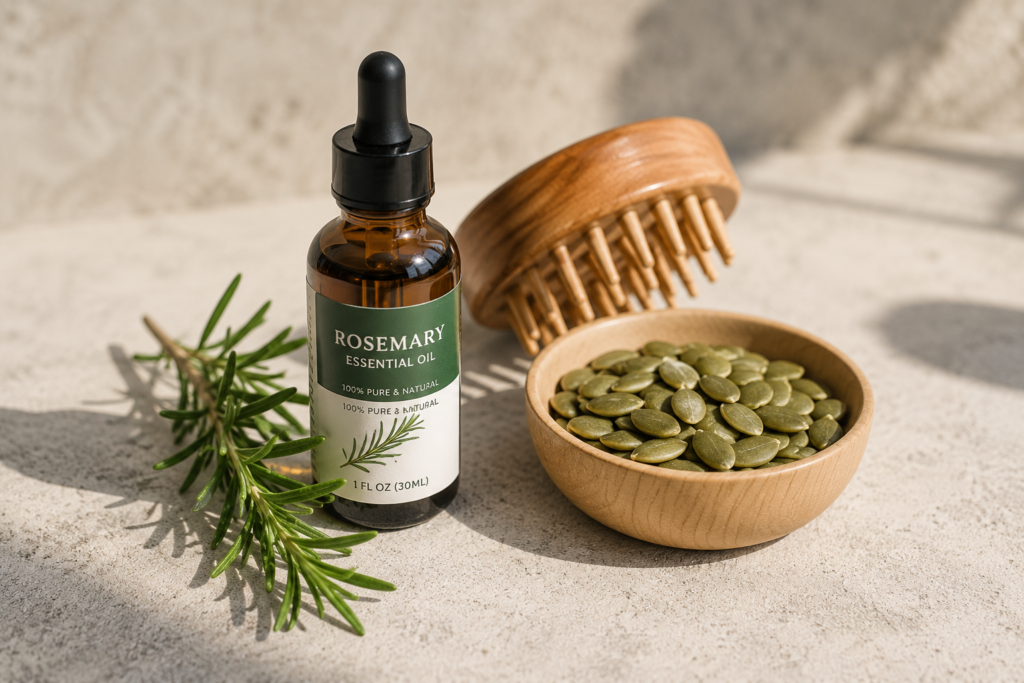
To stop hair loss naturally, you must address the specific underlying biological cause—either by inhibiting the hair-thinning hormone dihydrotestosterone (DHT), increasing blood flow to the hair roots, or correcting systemic nutritional deficiencies. Clinical studies show that certain natural interventions, such as topical rosemary oil, oral pumpkin seed oil, and standard saw palmetto extracts, can slow down hair shedding and support hair density by lowering DHT sensitivity and decreasing oxidative stress. However, natural remedies work slowly and are most effective for mild, early-stage thinning. If your hair follicles have been dormant or scarred over for years, pharmaceuticals or medical procedures are typically required to see visible regrowth.
- The Science Behind Natural Hair Restoration
- Evidence-Based Natural DHT Blockers
- Saw Palmetto (Serenoa repens)
- Pumpkin Seed Oil (Cucurbita pepo)
- Topical Botanicals: Rosemary Oil vs. Minoxidil
- Physical and Mechanical Interventions
- Standardized Scalp Massage
- Low-Level Laser Therapy (LLLT)
- 📊 Evidence-Based Natural Methods Comparison
- Correcting Nutritional and Lifestyle Triggers
- 1. Reversing Deficiencies
- 2. Lowering Systemic Cortisol
- Clinical Limits: When Natural Methods Are Not Enough
- Common Mistakes to Avoid with Natural Hair Care
- Key Takeaways
- Conclusion
- References
- Frequently Asked Questions (FAQs)
If you open any social media feed or search online for “how to stop hair loss naturally,” you will find thousands of unverified home remedies, DIY hair masks, and aggressive marketing campaigns promising miraculous transformations. This oversaturated landscape makes it incredibly difficult to separate marketing fluff from actual, peer-reviewed clinical science.
Wasting time and money on unverified alternative treatments carries a major biological cost. Hair loss is a time-sensitive issue. When hair follicles undergo genetic thinning, they gradually shrink (miniaturize) until they lose the capacity to grow terminal hairs entirely. Waiting too long to start an effective routine means losing hair that could have been saved.
This comprehensive guide completely bypasses unverified internet folklore. Instead, we look directly at peer-reviewed medical data, evaluating the exact mechanisms, safety risks, and clinical limitations of evidence-based natural hair care options.
The Science Behind Natural Hair Restoration
Featured Snippet Optimization: Natural hair loss treatments work by either mimicking the pathways of pharmaceutical options or improving the structural health of the scalp skin barrier. They can slow down shedding by partially blocking the 5-alpha reductase enzyme, lowering localized scalp inflammation, or dilating blood capillaries to deliver micronutrients to active hair bulbs.
To evaluate alternative remedies objectively, it helps to understand the baseline mechanics of hair loss. In the majority of men, thinning is driven by androgenetic alopecia (male pattern baldness). This is an inherited sensitivity to dihydrotestosterone (DHT), a powerful byproduct converted from standard testosterone by an enzyme called 5-alpha reductase. When DHT binds to sensitive follicles on the crown and hairline, it forces them into a prolonged resting state, shortening their active growth cycle until the hair falls out permanently.
Other temporary types of shedding, such as telogen effluvium, occur when severe physical stress, emotional trauma, or nutritional deficiencies shock large groups of hairs into an early resting state simultaneously. Natural methods can be highly useful here because they focus on optimizing the physiological conditions required for your hair roots to recover and complete their standard growth cycles safely.
Evidence-Based Natural DHT Blockers
Because DHT is the primary driver of male pattern baldness, stopping genetic thinning naturally requires finding compounds that can inhibit the 5-alpha reductase enzyme from executing that hormone conversion process.
Saw Palmetto (Serenoa repens)
Saw palmetto is a botanical extract sourced from the berries of a small palm tree native to the southeastern United States. It contains specific fatty acids and phytosterols that interact with metabolic pathways.
Clinical trials tracking mild-to-moderate androgenetic alopecia indicate that saw palmetto can partially block the activity of 5-alpha reductase, mimicking the basic pathway of pharmaceutical options on a much milder scale. In a comparative study published in the Journal of Alternative and Complementary Medicine, a daily oral dose of 320mg of saw palmetto extract resulted in measurable hair density improvements in nearly 38% of male participants over a two-year period.
Pumpkin Seed Oil (Cucurbita pepo)
Pumpkin seed oil contains high concentrations of phytosterols, tocopherols, and essential fatty acids that have been shown to disrupt the hormone conversion cycle.
In a landmark randomized, double-blind, placebo-controlled trial, researchers evaluated the effects of oral pumpkin seed oil capsules on men with mild-to-moderate hair loss. Participants consumed 400mg of pumpkin seed oil daily for 24 weeks. The final data revealed that the men taking the natural supplement experienced an average 40% increase in their baseline hair count, compared to just an 11% increase in the placebo control group, with no major negative side effects recorded.
Topical Botanicals: Rosemary Oil vs. Minoxidil
Featured Snippet Optimization: Clinical testing indicates that topical rosemary oil is as effective as 2% minoxidil for treating genetic hair loss when applied consistently over a six-month period. Rosemary oil operates by improving localized micro-circulation, reducing oxidative stress, and soothing secondary scalp irritation without causing intense skin flaking.
One of the most significant breakthroughs in natural hair care research focused directly on the comparison between rosemary essential oil and minoxidil, a standard over-the-counter hair growth medication.
In a randomized clinical trial published in the European journal Phytomedicine, researchers assigned patients with androgenetic alopecia to apply either rosemary essential oil or 2% minoxidil to their scalps twice daily for six months. At the 3-month mark, neither group showed visible changes. However, by month six, both groups demonstrated a statistically identical, significant increase in their hair counts.
Clinical Efficacy Flowchart
Comparative mechanism of action & 6-month hair regrowth outcome
Rosemary Oil
Topical Application
Extends Growth Phase & Lowers Inflammation
Equal Hair Count Boost
2% Minoxidil
Topical Application
Dilates Local Capillaries via Chemical Signal
Equal Hair Count Boost
An unexpected benefit noted in the study was that the group utilizing the natural rosemary oil experienced significantly less scalp itching, dryness, and skin irritation than the group using the chemical minoxidil solution.
Physical and Mechanical Interventions
Your physical routine can directly impact how well nutrients pass through your skin layers to feed developing hair roots.
Standardized Scalp Massage
The process of mechanically stimulating your scalp skin is a zero-cost method backed by basic circulatory science.
A study tracked by the National Institutes of Health (NIH) evaluated the visual impact of a daily, 4-minute standardized scalp massage performed using a mechanical massage tool. Over 24 weeks, the physical stretching forces applied directly to the scalp tissue modified the expression of genes in the dermal papilla cells. This mechanical stress essentially altered the cells’ shape, causing them to push out thicker individual hair shafts, resulting in an overall boost in hair thickness.
Low-Level Laser Therapy (LLLT)
Low-level laser therapy, or photobiomodulation, utilizes specific wavelengths of red light (typically around 650 nanometers) to stimulate biological tissues at a cellular level.
While it uses a modern home device, LLLT is a drug-free, non-invasive method formally cleared by regulatory bodies for early-stage thinning. The red light passes through the upper skin barrier, where it is absorbed by the mitochondria inside your hair cells. This process safely elevates cellular energy production (ATP), helping to extend the active anagen growth phase and pull sluggish follicles out of their resting state.
📊 Evidence-Based Natural Methods Comparison
| Natural Intervention | Primary Mechanism | Best Used For | Study Timeline | Key Limitation / Risk |
|---|---|---|---|---|
| Topical Rosemary Oil | Boosts local circulation; provides antioxidant safety. | Early thinning at the temples and hairline. | 6 Months | Must be diluted in a carrier oil to prevent skin irritation. |
| Oral Pumpkin Seed Oil | Partially blocks the 5-alpha reductase enzyme. | Mild, general crown thinning. | 24 Weeks | Requires continuous consumption; cannot fix advanced balding. |
| Scalp Massage | Applies mechanical stretching to widen hair shafts. | Boosting hair thickness and volume. | 24 Weeks | Requires strict daily discipline; cannot lower systemic DHT. |
| Low-Level Laser Therapy | Uses red light to boost cellular ATP production. | Mild to moderate genetic hair loss. | 16 – 26 Weeks | Higher upfront financial cost for a high-quality home device. |
Correcting Nutritional and Lifestyle Triggers
When your body enters a prolonged state of physical or metabolic stress, it prioritizes essential internal organs over non-essential hair cells, causing widespread shedding.
1. Reversing Deficiencies
Your hair cells replicate incredibly fast, making them highly sensitive to micronutrient drops. The Mayo Clinic highlights that specific gaps mimic or accelerate pattern shedding:
- Vitamin D: Essential for initializing the active growth phase. Low reserves are consistently linked to diffuse shedding.
- Iron (Ferritin): Helps red blood cells deliver oxygen to your roots. A drop in storage iron halts hair matrix replication.
- Zinc: An essential mineral co-factor involved in structural protein synthesis.
2. Lowering Systemic Cortisol
Chronic psychological stress causes your adrenal glands to release a flood of a hormone called cortisol. High, continuous cortisol exposure can directly shock up to 30% of your growing hair follicles out of their active growth phase early, shifting them into the telogen resting state. Managing stress through consistent sleep metrics, mindfulness exercises, and routine physical activity is a requirement to resolve stress-induced shedding.
Clinical Limits: When Natural Methods Are Not Enough
While alternative options provide clear structural benefits for early-stage maintenance, it is vital to retain realistic operational expectations. Natural remedies have a strict ceiling of efficacy:
Dormant Follicles Cannot Be Revived Naturally: If an area of your scalp has been completely bald, smooth, and shiny for years, the underlying hair follicles have likely undergone advanced fibrosis (scarring over). No amount of essential oil or massage can rebuild a scarred-over follicle.
Slower Timelines: Pharmaceutical options like oral finasteride or topical minoxidil alter hormone and blood flow patterns rapidly. Natural options operate on a much slower, more subtle timeline. You must commit to a routine for a minimum of six months before evaluating whether a natural method is working for you.
Potential for Scalp Allergies: Essential oils are highly concentrated chemical structures. Applying undiluted rosemary or peppermint oil directly to your scalp skin can cause severe allergic contact dermatitis, leading to skin burns, increased inflammation, and temporary hair shedding.
Common Mistakes to Avoid with Natural Hair Care
Using Pure Essential Oils Undiluted: Always mix essential oils into a safe carrier oil like jojoba, argan, or grapeseed oil before application. A standard, safe ratio is roughly 2 to 3 drops of essential oil per tablespoon of carrier oil.
Assuming All Hair Loss Is Genetic: If your hair is falling out suddenly in large patches (alopecia areata) or accompanied by severe scaling and burning, you may be dealing with an autoimmune issue or a fungal scalp infection. These conditions require immediate diagnosis and specialized treatment from a dermatologist, not home remedies.
Constantly Shifting Routines: Many users try a natural oil for three weeks, see no immediate change, abandon it, and buy a different tonic. This constant shifting restarts your progress window and continuously irritates your scalp skin barrier.
Key Takeaways
- Topical rosemary oil has been clinically proven to match the effectiveness of 2% minoxidil when utilized consistently for six months.
- Oral pumpkin seed oil supplements can help reduce hair loss by partially blocking the 5-alpha reductase enzyme that generates DHT.
- Daily scalp massages apply mechanical stretching forces to cellular structures, helping to widen the physical diameter of growing hair shafts.
- Natural remedies are highly effective at slowing down early thinning but cannot regrow hair in areas where follicles have completely scarred over.
- Always dilute essential oils inside a safe carrier oil base to protect your scalp skin barrier from contact dermatitis risks.
Conclusion
Can you stop hair loss naturally? The scientific data answers with a conditional yes. If you catch thinning early, optimize your nutritional reserves, manage your stress metrics, and deploy clinically studied solutions like rosemary oil and pumpkin seed oil with strict daily consistency, you can slow down shedding and protect your existing hair density.
However, you must separate natural health from wishful thinking. Natural remedies cannot rewrite your genetic code or revive long-dead hair roots. Take an honest look at your current hair density, set realistic goals, and protect your scalp skin barrier from harsh, unverified home remedies. If your thinning resists home care or causes severe scalp irritation, schedule an evaluation with a board-certified dermatologist to ensure you manage your body safely and effectively.
References
- National Institutes of Health (NIH). Androgenetic alopecia. MedlinePlus Genetics. Available at: medlineplus.gov
- Murugusundram, S. Serenoa Repens in Androgenetic Alopecia. Journal of Cutaneous and Aesthetic Surgery. Available at: nih.gov
- Panahi, Y., et al. Rosemary oil vs minoxidil 2% for the treatment of androgenetic alopecia: a randomized comparative trial. Phytomedicine Journal. Available at: nih.gov
Frequently Asked Questions (FAQs)
How long does it take to see results when stopping hair loss naturally?
Natural treatments require a minimum commitment of six months of consistent daily use before you can see measurable changes in hair count or thickness. This timeline is dictated by the natural resting and growth phases of human hair follicles, which take months to transition and push a new strand through the skin barrier.
Can coconut oil stop male pattern baldness?
No, coconut oil cannot stop genetic hair loss or lower DHT levels on the scalp. While it contains healthy fatty acids that help reduce protein loss in existing hair strands, it does not interact with the 5-alpha reductase enzyme or alter hormone sensitivities.
Is it safe to combine rosemary oil with saw palmetto?
Yes. Because topical rosemary oil improves local blood flow and lowers scalp inflammation, while oral saw palmetto works systemically to partially block DHT production, these two options target entirely different biological pathways and can be used together safely.
Can a vitamin deficiency cause your hair to fall out in patches?
No, nutritional deficiencies typically cause diffuse, uniform thinning across the entire scalp. If your hair is falling out in smooth, distinct coin-sized round patches, it is usually a sign of an autoimmune condition like alopecia areata, which requires evaluation by a dermatologist.
Does quitting smoking help stop hair loss?
Yes. Cigarette smoke introduces intense oxidative stress and toxins that can damage the delicate cellular structure of your hair roots. Quitting smoking helps restore healthy micro-circulation to your scalp capillaries, ensuring optimal delivery of oxygen and nutrients to your growing hair.