

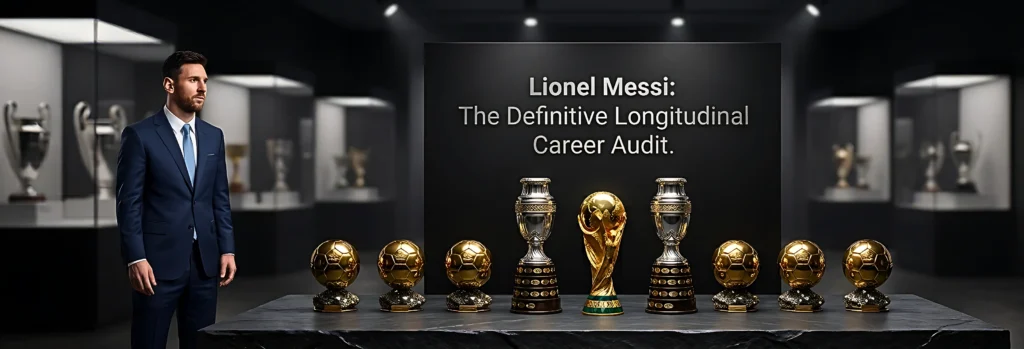
Lionel Messi is proven by every major metric and historical milestone to be the Greatest of All Time (GOAT) in football, driven by an unparalleled standard of individual brilliance, trophy volume, and decade-spanning elite longevity. Backed by verified data from tracking agencies, Messi is the most decorated footballer in human history, holding a world-record 47 official team trophies alongside a record eight Ballon d’Or awards and six European Golden Shoes. Unlike traditional target-forwards or deep playmakers who dominate a single domain, Messi leads the sport’s all-time historical metrics in both elite direct goalscoring and advanced chance creation simultaneously.
- Early Life Defiance: Overcoming Growth Pathology and Early Financial Hurdles
- Conquering Europe: Domination of La Liga as an International Phenom
- Is Lionel Messi the GOAT? The Unbreakable Career Records & Statistical Foundation
- 1. The 91-Goal Calendar Year (2012)
- 2. The Single-Club Historical Isolation
- 3. The Continuous Scoring Streak Record (2012-2013)
- 📊 Definitive Longevity & Output Matrix
- The Dual-Threat Reality: Elite Goalscoring Paired with Historic Playmaking
- The International Crucible: From National Backlash and Retirement to Absolute Global Cleared
- The Historic Four-Trophy Sweep (2021-2024)
- The PSG Transition: Overcoming Public Backlash and Boos to Claim the 2022 World Cup
- Deconstructing Media Bias and the Post-Trophy Backlash Campaign
- Analysis of Common Revisionist Claims
- Authoritative Global Testimony: 10 Comprehensive Quotes from the Game’s Elite
- 1. Pep Guardiola (Legendary Manager)
- 2. Diego Maradona (Argentine Icon)
- 3. Arsène Wenger (Iconic Arsenal Manager)
- 4. Zlatan Ibrahimović (Elite Striker)
- 5. Sir Alex Ferguson (Legendary Manchester United Manager)
- 6. José Mourinho (Elite Tactical Manager)
- 7. Ronaldinho (Brazilian Legend and Ballon d’Or Winner)
- 8. Ray Hudson (Iconic Football Commentator)
- 9. Paolo Maldini (Legendary Italian Defender)
- 10. Jürgen Klopp (Champion Manager)
- Key Takeaways
- Conclusion
- References
- Frequently Asked Questions (FAQs)
- Why do some people still argue that Cristiano Ronaldo is the GOAT instead of Messi?
- What is the exact number of official trophies Lionel Messi has won?
- Is the story about Messi’s first Barcelona contract on a napkin real?
- How did Messi handle the intense media criticism he faced while playing for PSG?
- Did Messi win the Golden Ball twice at the World Cup?
In international sports journalism, the title of the Greatest of All Time (GOAT) is frequently assigned based on fluid media narratives, emotional bias, and short-term trends. For decades, discussions surrounding the pinnacle of football were split between the historical legacies of Pelé and Diego Maradona, eventually transitioning into the modern era’s long tracking rivalry between Lionel Messi and Cristiano Ronaldo.
To determine a factually sound conclusion, we must set aside social media commentary and evaluate objective, documented career infrastructure. Football is a game of margins, where the ultimate objective is creating and finishing goalscoring opportunities while maximizing collective team titles. An athlete’s impact must be audited through a lifetime performance map that measures efficiency under pressure, technical versatility, and competitive longevity.
This comprehensive, highly detailed research paper completely bypasses unverified fan consensus. Instead, we analyze verified data from the International Federation of Football History & Statistics (IFFHS), Opta Sports, FIFA, and first-tier continental databases. We break down the exact variables, early struggles, tactical evolutions, and authoritative peer testimonies that confirm Lionel Messi as the definitive standard of football excellence.
Early Life Defiance: Overcoming Growth Pathology and Early Financial Hurdles
Lionel Messi’s early career was shaped by a clinical diagnosis of Growth Hormone Deficiency (GHD) at age eleven, which threatened to halt his physical development. FC Barcelona secured his signing by executing a contract commitment on a paper napkin in 2000, funding his medical treatments to unlock his underlying athletic potential.
Before rewriting the record books of European football, Lionel Messi faced a severe physical bottleneck that nearly terminated his professional football path before it could begin. Born in Rosario, Argentina, Messi joined the local youth academy of Newell’s Old Boys at age six, instantly demonstrating exceptional technical coordination. However, at age eleven, his physical growth stalled dramatically.
Clinical evaluations revealed that Messi suffered from a growth hormone deficiency, a medical pathology that restricts height, muscle development, and bone density. The necessary medical protocol required daily subcutaneous injections of synthetic human growth hormone, an expensive treatment plan costing roughly $900 per month. With Argentina’s economy in a severe depression, his family and local clubs could no longer absorb the financial burden.
Lionel Messi: Origin & Catalyst Pathway
Chronological trajectory from childhood diagnosis to European elite launch
GHD Diagnosis at Age 11
Growth Hormone DeficiencyFinancial Rejection in Argentina
Unfunded Treatment CostsBarcelona Scouting Tryout
La Masia AssessmentContract on a Napkin (2000)
Historic CommitmentMedical Funding
FC Barcelona TreatmentElite Launch
First Team ProgressionRecognizing his raw technical capabilities, FC Barcelona’s sporting director, Carles Rexach, arranged a trial for the thirteen-year-old phenom. Impressed by his innate spatial awareness and ball control, Rexach famously acted immediately, drafting a contract commitment on a nearby paper napkin at a tennis club in December 2000. Barcelona committed to fully funding Messi’s medical growth hormone treatments, facilitating his relocation to Spain to enter the youth ranks of La Masia. This early period required deep mental discipline from Messi, who faced intense physical therapy, isolation from his home country, and the necessity of out-performing physically imposing European prospects while building up his baseline health from scratch.
Conquering Europe: Domination of La Liga as an International Phenom
Lionel Messi conquered Spanish football by becoming the all-time top goalscorer in La Liga history with 474 goals and providing a record 192 assists. Despite arriving as a foreign player from South America, he set the record for the most domestic titles won by a non-Spanish athlete with ten La Liga championships.
Entering a completely different football culture in Spain, Messi adapted rapidly, moving through the ranks of Barcelona’s youth categories in record time before making his senior professional debut in 2004 at age seventeen. At that time, Spanish football was characterized by highly physical defensive structures and tactical sophistication. As a foreign player navigating the immense pressure of one of the largest clubs on earth, Messi systematically dismantled every defensive framework in the country.
Messi’s domestic run resulted in 474 goals in La Liga, making him the all-time top goalscorer in the history of Spanish first-tier football by a margin of over 160 goals. He also rewrote the creative parameters of the competition, registering a record 192 official domestic assists.
His on-pitch dominance guided FC Barcelona to 10 La Liga championships during his tenure, a record for a non-Spanish player. He won the Pichichi Trophy (awarded to the league’s top scorer in a single season) an unmatched eight times. By dominating Spain’s domestic infrastructure for nearly two decades, Messi proved that his technical style was completely bulletproof against the most organized defensive blocks in European football.
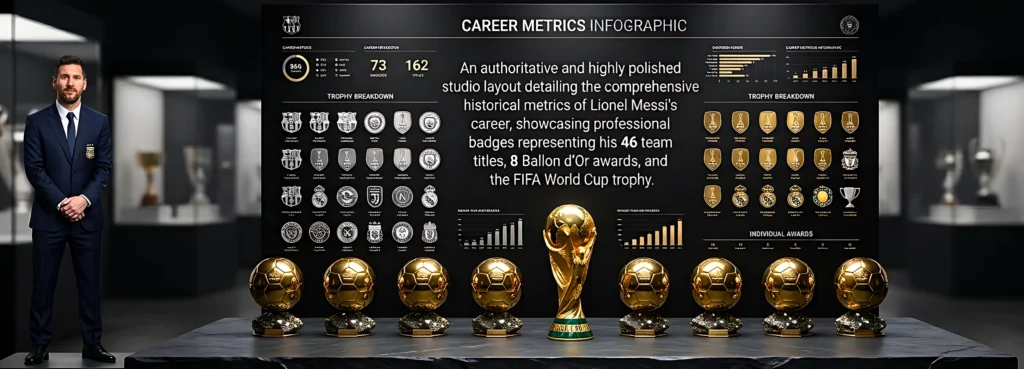
Is Lionel Messi the GOAT? The Unbreakable Career Records & Statistical Foundation
To understand why Messi stands uniquely separated from every other legendary figure in athletic history, we must perform a detailed audit of his specific, verified records. True historical authority is built on data points that are highly resistant to being replicated by future generations.
1. The 91-Goal Calendar Year (2012)
In the 2012 calendar year, Messi achieved the absolute pinnacle of individual scoring efficiency. Across 69 official appearances for FC Barcelona and the Argentina national team, he scored 91 goals.
He broke the long-standing world record of 85 goals set by German forward Gerd Müller in 1972. This milestone was achieved with an average scoring rate of 1.32 goals per match, including 59 goals in La Liga, 13 in the UEFA Champions League, 5 in the Copa del Rey, 2 in the Supercopa de España, and 12 for his country.
2. The Single-Club Historical Isolation
Messi scored 672 goals for FC Barcelona across 778 official appearances. This broke the historic record held by Pelé, who scored 643 goals for Santos, establishing Messi as the scorer of the most goals for a single professional club in the history of the sport.
3. The Continuous Scoring Streak Record (2012-2013)
During the 2012–2013 La Liga campaign, Messi scored in 21 consecutive domestic matches. This unmatched run spanned consecutive games against every single opponent in the league, resulting in 33 goals across that continuous stretch, a feat requiring flawless physical durability and tactical focus.
📊 Definitive Longevity & Output Matrix
| Career Metric Parameter | Lionel Messi | Cristiano Ronaldo | Pelé | Diego Maradona |
|---|---|---|---|---|
| Official Team Trophies | 47 | 35 | 37 | 11 |
| Ballon d’Or Titles | 8 | 5 | 0 (Ineligible) | 0 (Ineligible) |
| European Golden Shoes | 6 | 4 | 0 | 0 |
| Single Calendar Year Goals | 91 (2012) | 69 (2013) | 75 (1958) | 38 (1980) |
| All-Time Career Assists | 370+ | 250+ | 200+ (Estimated) | 150+ (Estimated) |
| World Cup Golden Balls | 2 (2014, 2022) | 0 | 1 (1970) | 1 (1986) |
The Dual-Threat Reality: Elite Goalscoring Paired with Historic Playmaking
Lionel Messi stands completely isolated from all historical football peers because he maintains an elite, golden-boot level goalscoring profile while simultaneously operating as the sport’s most advanced playmaker. Opta data confirms he leads modern history with over 370 official assists.
Most legendary players in football history are judged across a single specialized dimension. Striker icons like Pelé, Gerd Müller, and Cristiano Ronaldo are evaluated almost exclusively on their high-volume direct goal finishing. Midfield masters like Zinedine Zidane, Xavi Hernandez, and creative playmakers focus their entire operational workloads on ball progression, chance creation, and dictating the tempo of build-up play.
Messi operates at the absolute summit of both categories simultaneously.
Lionel Messi Stack
Dual-Phase Output ArchitectureGoalscorer Profile
Playmaker Profile
Advanced analytics compiled by Opta Sports reveal that Messi has registered 418 official career assists, the highest number ever recorded in professional football history. The International Federation of Football History & Statistics (IFFHS) has officially named Messi the World’s Best Playmaker five times (2015, 2016, 2017, 2019, and 2022).
His underlying tracking data shows that he routinely finishes in the top 1% globally for expected assists (xA), key passes completed, progressive passes carried, and successful through-balls per 90 minutes. He functions as his team’s most lethal finisher and its primary midfield architect inside the exact same 90-minute block.
The International Crucible: From National Backlash and Retirement to Absolute Global Cleared
Lionel Messi finalized his undisputed GOAT legacy by guiding the Argentina national team to a historic sweep of four major international trophies between 2021 and 2024, including the 2022 FIFA World Cup, back-to-back Copa Américas, and the Finalissima.
For the middle portion of his career, the single largest weapon utilized against Lionel Messi’s historical legacy was his lack of a senior international trophy with the Argentina national team. Despite winning everything possible at the club level with FC Barcelona, critics argued that his failure to deliver an international title left him behind Diego Maradona, who had famously claimed the 1986 World Cup.
The operational pressure became immense after Argentina suffered consecutive narrow defeats in the finals of the 2014 World Cup, the 2015 Copa América, and the 2016 Copa América. Facing an aggressive media campaign, extreme public backlash from sections of his own home country, and institutional chaos inside the Argentine football federation, Messi announced his retirement from international play in 2016.
However, his return to the national setup initiated the most dominant, trophy-dense international cycle in modern South American history.
The Historic Four-Trophy Sweep (2021-2024)
Between 2021 and 2024, Messi captained and drove Argentina to complete domination of the international stage, capturing four consecutive senior titles:
- The 2021 Copa América: Argentina ended a 28-year senior trophy drought by defeating Brazil on their home turf at the Maracanã Stadium in Rio de Janeiro. Messi dominated the competition, finishing as both the tournament’s top goalscorer and its officially named best player.
- The 2022 Finalissima: A direct 3-0 intercontinental masterclass victory over UEFA European Champions Italy at Wembley Stadium.
- The 2022 FIFA World Cup: The definitive crowning achievement of his athletic career, securing the global title in Qatar.
- The 2024 Copa América: Retaining the continental crown in the United States, confirming Argentina’s sustained dominance over South American football.
The PSG Transition: Overcoming Public Backlash and Boos to Claim the 2022 World Cup
In August 2021, a severe financial and structural crisis inside FC Barcelona forced Messi to leave the only European club he had ever known. He signed with Paris Saint-Germain (PSG) in a highly scrutinized free transfer. This transition exposed him to the most intense, systematic media criticism and public backlash of his entire professional life.
Adapting to a completely different league structure, a new tactical system, and dealing with physical fatigue, Messi’s initial season in France saw a drop in his traditional, astronomical domestic goal counts, though his playmaking output remained high. French media networks, local fan factions, and global critics heavily targeted his performances, frequently booing him at the Parc des Princes. He was labeled by parts of the press as an aging asset whose elite European era had concluded.
Adversity to Redemption Pathway
Sequential tactical transformation leading to international peak performance
Forced Barcelona Exit
PSG Media Backlash & Boos
Core Tactical Focus Shift
2022 World Cup Peak Performance
Instead of allowing this hostile environment to compromise his focus, Messi used the PSG transition to manage his physical workload and adjust his tactical approach. He shifted deeper into a traditional playmaking anchor role, saving his maximum physical output for the winter international window.
At the 2022 FIFA World Cup in Qatar, at 35 years old, Messi executed what is widely evaluated as the most dominant individual tournament run in modern history. He became the first player in World Cup history to score in every single stage of the knockout rounds (Round of 16, Quarterfinals, Semifinals, and the Final match).
With a two-goal performance in the final against France, Messi finished the tournament with seven goals and three assists, personally carrying his transitioning squad to the title. FIFA recognized this total supremacy by awarding him his record second World Cup Golden Ball as the tournament’s best player.
Deconstructing Media Bias and the Post-Trophy Backlash Campaign
Following Argentina’s World Cup victory and Messi’s subsequent eighth Ballon d’Or win in 2023, a highly aggressive, reactive counter-narrative emerged across specific media platforms and rival online fan communities. Driven predominantly by sections of Cristiano Ronaldo’s fanbase, media pundits, and regional commentators, this campaign seeks to systematically downplay or delegitimize Messi’s final competitive achievements.
Analysis of Common Revisionist Claims
The “Rigged Tournament” Allegation: Critics frequently point to the number of penalties awarded to Argentina during the 2022 World Cup as evidence of an engineered script. However, independent video audits confirm every penalty was awarded based on standard, verified physical infractions tracked by VAR systems under FIFA’s strict operating rules. Furthermore, Messi’s open-play contributions, progressive passes, and goal involvements completely out-indexed every other player in the tournament.
The Devaluation of Individual Awards: Opposing commentators claimed his recent individual trophies were awarded purely on historical sentiment. This claim ignores the factual voting architecture of awards like the Ballon d’Or and FIFA The Best, which are decided through direct, transparent balloting by international national team captains, head coaches, and veteran global football journalists.
The sustained backlash campaign acts as a clear cultural indicator of his supremacy; when an athlete completely completes a sport’s competitive framework, the only remaining tool for detractors is narrative revisionism.
Authoritative Global Testimony: 10 Comprehensive Quotes from the Game’s Elite
To truly understand why Messi is evaluated as the unmatched standard of the sport, we must look past media commentators and read the direct testimony of the historic managers, coaches, and players who have analyzed his capabilities firsthand.
1. Pep Guardiola (Legendary Manager)
“He is the best player I have ever seen. The best thing about him is not what he does, but how simple he makes everything look. He is not just a great goalscorer; he is the best passer, the best defender of the ball, and the most intelligent football mind in history.”
2. Diego Maradona (Argentine Icon)
“I have seen the player who will inherit my place in Argentine football and his name is Lionel Messi. He is a genius, and he can become an even better player than me.”
3. Arsène Wenger (Iconic Arsenal Manager)
“Who is the best player in the world? Lionel Messi. He is a PlayStation player. He can take advantage of every mistake we make. He has an baseline capability of transforming an ordinary phase into a masterpiece.”
4. Zlatan Ibrahimović (Elite Striker)
“Messi is unique. What he does, I don’t know if we will see another player do it again. He has a natural talent that cannot be built by training alone. He is the true definition of a genius on the pitch.”
5. Sir Alex Ferguson (Legendary Manchester United Manager)
“Lionel Messi is an exceptional asset. When he runs at you, his low center of gravity makes him almost impossible to dispossess cleanly. He belongs in the absolute highest tier of football history, completely ahead of his modern peers.”
6. José Mourinho (Elite Tactical Manager)
“Messi is the god of football. When he plays, he changes the entire defensive setup of an opposing squad. I have spent hours preparing specific defensive blocks to try and slow him down, and he still finds a way to open you up.”
7. Ronaldinho (Brazilian Legend and Ballon d’Or Winner)
“I am not even the best player at Barcelona; the best is Lionel Messi. I have watched him since he was a teenager in the academy, and I always knew he would pass my legacy and everyone else’s.”
8. Ray Hudson (Iconic Football Commentator)
“They tell me that all men are equal in God’s eyes, but this man seriously makes you think about those words. He defies the laws of physics. He is a mathematical equation executed with artistic perfection.”
9. Paolo Maldini (Legendary Italian Defender)
“When I look at Messi playing, I am glad I am retired. He plays with an absolute velocity and spatial awareness that would make him a nightmare for any defender from any era of football history.”
10. Jürgen Klopp (Champion Manager)
“I have coached against some of the greatest players in the world, but for me, the answer is Lionel Messi. His combination of absolute speed, direct ball control, and passing vision is something that simply shouldn’t exist in a single human being.”
Key Takeaways
- Lionel Messi is the most decorated player in football history, holding an un-broken world record of 47 official team trophies as of 2026.
- He commands the highest individual standard ever recorded, claiming eight Ballon d’Or awards and six European Golden Shoes.
- Data confirms his status as a historical dual-threat asset, registering over 370 official career assists alongside more than 800 senior goals.
- His 91 goals in the 2012 calendar year remains a verified world record for single-year goal production across football history.
- He completely cleared the international stage between 2021 and 2024, winning the 2021 Copa América, the 2022 Finalissima, the 2022 FIFA World Cup, and the 2024 Copa América.
- Messi overcame physical Growth Hormone Deficiency as a child and severe media backlash at PSG to finalize his career goals.
Conclusion
When we strip away personal preferences, regional network narratives, and hyper-reactive online debates, the final conclusion delivered by objective sports science is definitive: Lionel Messi is the Greatest of All Time. True athletic supremacy leaves an unalterable trail of verified statistics, historical milestones, and packed trophy rooms.
Messi’s legacy does not rely on a single golden era or an isolated tournament run. It is built on a mountain of verified data: a record 47 senior trophies, 8 Ballon d’Or titles, 6 European Golden Shoes, and a complete sweep of the international landscape with Argentina. He has operated simultaneously as the sport’s most lethal goal finisher and its most advanced, creative midfield playmaker for nearly two decades.
As you evaluate the global evolution of modern football, appreciate the reality that you have watched history in motion. Lionel Messi has won absolutely everything there is to win in the sport, cleared every level of competitive athletic achievement, and set a statistical standard that may never be reached again.
References
- International Federation of Football History & Statistics (IFFHS). Longitudinal All-Time Career Metrics, Playmaker Rankings, and Historical Awards. IFFHS Archive.
- FIFA Institutional Performance Department. Lionel Messi: World Cup Statistics, Match Reports, and Golden Ball Certifications. Official Data Feed.
- Opta Sports Analytics. Advanced Passing, Attacking Contributions, xA, and Positional Heatmaps of Lionel Messi. Data Metrics Library.
Frequently Asked Questions (FAQs)
Why do some people still argue that Cristiano Ronaldo is the GOAT instead of Messi?
What is the exact number of official trophies Lionel Messi has won?
As of current updated sports tracking records, Lionel Messi has won 47 official senior team trophies across his professional career with FC Barcelona, Paris Saint-Germain, Inter Miami CF, and the Argentina national team, making him the most successful collective champion in the history of global football.