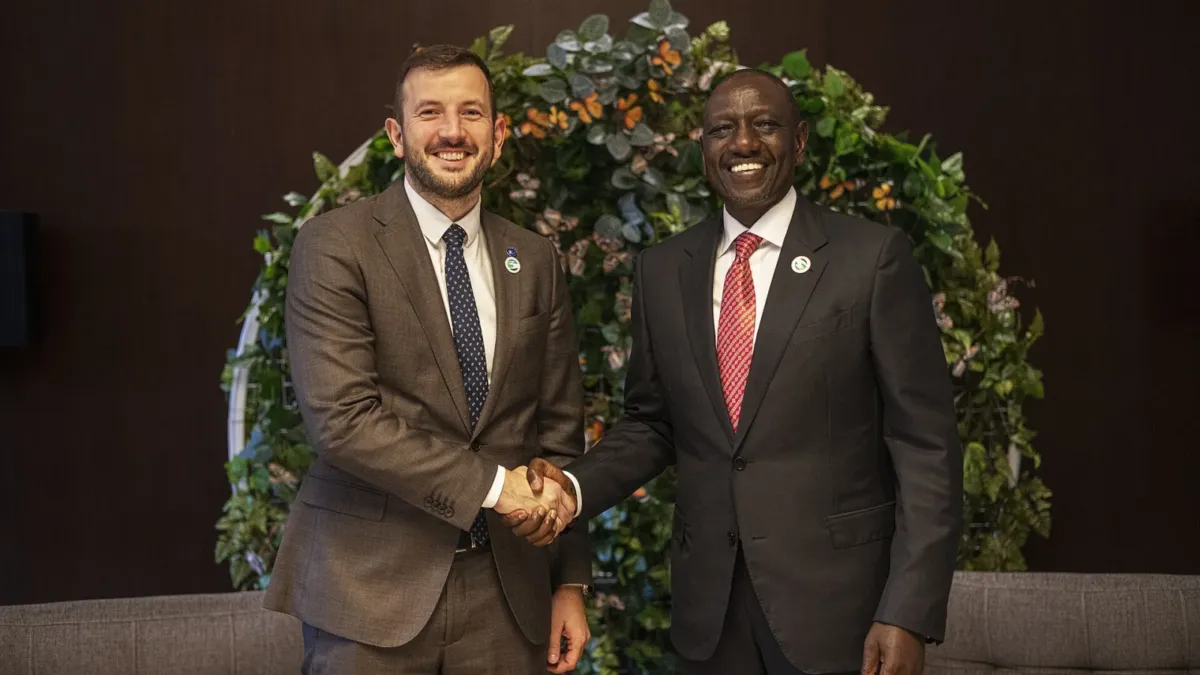
President William Ruto proposed on Wednesday to exempt workers earning Sh32,333 or less a month from PAYE, as he delivered the final State of the Nation Address of his first term.
Ruto also proposed no stamp duty on land transactions worth Sh1 million or less and the removal of the 25% import duty on mobile phones, and said the government had proposed the measures to Parliament, KBC reported.
Ruto first floated the PAYE exemption on Mashujaa Day, Oct. 20, in Eldoret, Capital FM reported at the time. It said the change would require legislative processes before taking effect. Capital FM quoted him as saying the move would “increase disposable income for low-income households.”
Ruto spoke to a joint sitting of the National Assembly and Senate at Parliament in Nairobi. The Star reported that it was his last address before the August 2027 general election, and lawmakers chanted “Tutam” and “Usawa ni sawa” as he took the podium.
Attendees included the First Lady, Deputy President Kithure Kindiki, Prime Cabinet Secretary Musalia Mudavadi, ODM leader Oburu Oginga and Chief Justice Martha Koome, KBC reported.
Economic record Ruto cited in the State of the Nation Address
Ruto said the shilling trades at about Sh129 to the dollar, against about Sh162 in 2022, and that inflation averaged 4.1% in 2025 compared with 9.6% in 2022, according to KBC. Foreign exchange reserves rose from $7.37 billion to a peak of $15.3 billion, he said.
He said growth had continued despite external shocks. “Despite global uncertainty and disruptions to international trade, our economy has been expanding,” he said.
On pending bills, Ruto said 28,726 verified claims worth Sh27.8 billion had been approved for payment. The Treasury approved Sh18 billion for public universities and Sh16 billion for hospitals under the former NHIF, KBC reported.
Ruto said a Sh1.2 billion bonus for sugar cane farmers would be disbursed the following week. Cane crushed rose 57% and sugar output 60% from January to October, and output is projected to pass 900,000 tonnes by year-end, KBC reported.
Ruto said about 7,000 km of road is under construction, KBC reported. According to the full text published by Uzalendo News, he said the National Infrastructure Fund has been capitalised with Sh340 billion. That Sh340 billion is 6.8% of a Sh5 trillion target, Kenyans.co.ke reported. The Uzalendo text said the Sh5 trillion is the estimated cost of the whole transformation programme over 10 years.
Ruto said Sh1.55 trillion went to counties as their equitable share over four years, with a further Sh428 billion allocated this financial year, according to KBC.
Education, health and housing
Ruto said the government hired 100,000 teachers in four years and plans to hire 20,000 more. He said 23,000 classrooms were built and 1,600 laboratories are under construction, and that the education budget rose from Sh521 billion to Sh784 billion, KBC reported.
A record 3.6 million learners sat the KPSEA, KJSEA and KCSE examinations this week, according to KBC. “Examinations are a normal part of learning, not a security operation or a matter of life and death,” Ruto said. Uzalendo’s copy of the speech said he added: “For the first time in 65 years, examination papers were printed here in Kenya.”
On health, Ruto said 33.7 million people are registered with SHA, compared with about 8 million under NHIF, KBC reported. He cited 53,465 patients on cancer treatment, 24,468 on dialysis and 89 kidney transplants.
According to KBC, more than 313,000 affordable homes are at various stages and housing construction has created over 1.1 million jobs. The speech text said 707,000 Kenyans found jobs abroad and 350,000 work in the digital economy. Kenyans.co.ke said 18,000 Kenyans have been allocated homes.
What the PAYE proposal means for salaried Kenyans
For salaried Kenyans, the PAYE proposal is the item to watch. It would apply to people earning Sh32,333 or less a month. Capital FM reported that the change needs legislation first, so payslips would change only after Parliament acts.
A live blog by Kenyans.co.ke checked several of the president’s claims against official data. The table shows two of those comparisons.
| Topic | Claim in the speech or on the day | Figure cited by Kenyans.co.ke |
|---|---|---|
| Dairy exports | Sh11.2 billion | Sh9.4 billion, given by Kindiki on Oct. 7 |
| Sugar | Output up 60% from January to October; above 900,000 tonnes projected by year-end | KNBS and Kenya Sugar Board: 690,520 tonnes from January to September, up 56.7%; previous record 815,454 tonnes in 2024 |
On dairy exports, the president’s figure was Sh1.8 billion above the one Kindiki gave on Oct. 7. The sugar projection of more than 900,000 tonnes would beat the 2024 record of 815,454 tonnes.
Background on how much the Kenya Revenue Authority collects is in an earlier report on the KRA Sh1 trillion revenue mark.
What the speech did not cover
The live blog reported that the speech did not address fuel pump prices or electricity tariffs, did not mention court challenges to revenue-raising laws, and gave no full update on public debt. Kenyans.co.ke’s own analysis put public debt at Sh13.48 trillion by August 2026.
The speech ran about two hours. Ruto closed by calling the task a generational assignment and urging continuity, according to the live blog.
What happens next
Ruto handed three reports to the Speakers of the Senate and the National Assembly, according to the Uzalendo text. Debate on the address is expected from Thursday, Nov. 19, Kenyans.co.ke reported.
The general election is due in August 2027, and the IEBC has begun a review of the nomination rules of 105 parties.