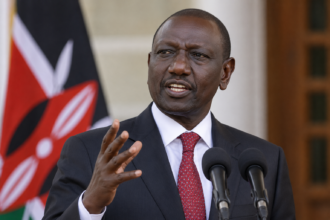


NAIROBI (GG) — Kenyan President William Ruto on Saturday challenged commercial banks and private sector lenders to aggressively expand credit access to small businesses, revealing that the country’s small-scale sector faces an estimated Sh3 trillion ($23 billion) funding deficit.
Speaking during the World Micro, Small, and Medium-sized Enterprises (MSME) Day celebrations at the Kenyatta International Convention Centre (KICC) in Nairobi, the president formally unveiled the Revised MSMEs Policy 2026. The new policy framework seeks to dismantle long-standing bureaucratic bottlenecks, streamline regulatory controls, and create an inclusive pathway to formalize millions of informal traders across the country.
President Ruto emphasized that while small enterprises account for roughly 40 percent of Kenya’s gross domestic product, the vast majority remain locked out of mainstream financial services. He noted that although local commercial banks have advanced approximately Sh1 trillion to the sector over the past three years, the capital flow remains drastically insufficient to fulfill the operational demands of expanding grassroots enterprises.
To bridge the financial divide, the head of state urged banking executives to shift away from traditional asset-backed collateral requirements, such as land title deeds and automotive logbooks, which have historically disqualified low-income entrepreneurs from borrowing. Instead, Ruto announced that the federal government is collaborating with financial institutions to implement a National Credit Score system. The upcoming framework will allow banks to leverage automated repayment histories from state initiatives like the Hustler Fund to assess a borrower’s character and risk profile dynamically.
Co-operatives and MSMEs Development Cabinet Secretary Wycliffe Oparanya confirmed that the newly launched 2026 policy contains targeted provisions designed to eliminate entry barriers for young entrepreneurs. According to ministry officials, the structural revisions will complement existing state-backed programs, including the Youth Enterprise Fund, the Women Enterprise Fund, and the National Youth Opportunities Towards Advancement (NYOTA) initiative, by facilitating smoother integration into local supply chains.
The administrative push for financial inclusion was echoed by United Nations Resident Coordinator Garry Conille, who attended the Nairobi summit. Conille praised the structural changes, stating that expanding credit networks to ambitious but underfunded citizens represents a vital state decision to make grassroots commerce visible to the broader national economy rather than treating financial inclusion as an act of public charity.
The national government’s policy rollout coincides with ongoing ease-of-doing-business overhauls at the municipal level. Nairobi Governor Johnson Sakaja informed delegates at the convention that the introduction of the county’s Unified Business Permit has significantly reduced bureaucratic redundancies and shortened the licensing windows for traders operating within the capital city.