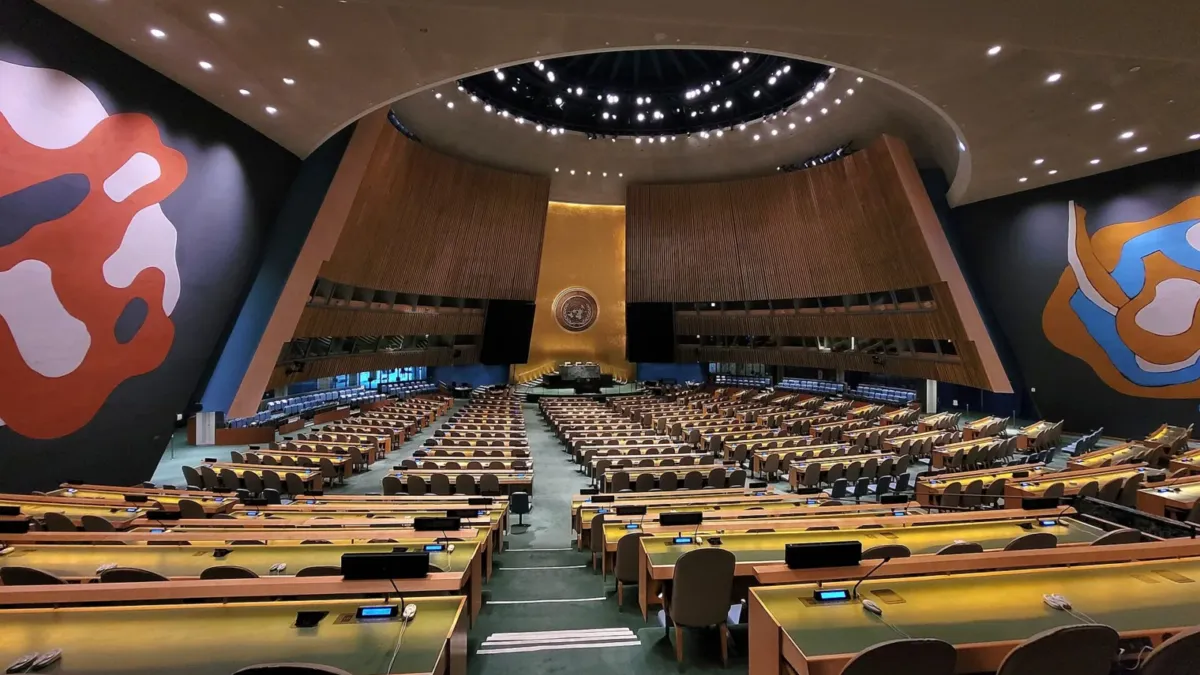
Somalia was the only country to vote against a UN resolution on violence against women and girls in a General Assembly committee on Tuesday, when the text passed 175 to 1 with six abstentions.
The Third Committee of the General Assembly, which handles social, humanitarian and cultural questions, approved draft resolution A/C.3/81/L.16/Rev.1 on Nov. 17 by recorded vote, according to a UN press release. Argentina, Belarus, Burkina Faso, Cameroon, Russia and the United States abstained.
Somalia’s UN mission had not publicly explained its vote, according to Eastleigh Voice and Kenya Today at the time of their reports. The vote was held in committee, and the full General Assembly is expected to adopt the text in December, Health Policy Watch reported.
What the UN resolution on violence against women says
The resolution, titled “Intensification of efforts to prevent and eliminate all forms of violence against women and girls,” condemns all forms of such violence, online and offline, according to the UN. It singles out gender-related killings, including femicide.
France and the United Kingdom sponsored the text, Health Policy Watch reported. It urges governments to take comprehensive, gender-responsive measures, to address risk factors through legislation and policies and to protect women and girls from online defamation and hate speech.
The committee rejected 11 amendments, by recorded vote or by no-action motion, before it adopted the draft, the UN said.
The vote tally
The table shows the recorded vote as published in the UN press release. It counts 182 recorded positions in all.
| Position | Votes | Countries |
|---|---|---|
| In favour | 175 | All other members voting |
| Against | 1 | Somalia |
| Abstentions | 6 | Argentina, Belarus, Burkina Faso, Cameroon, Russia, United States |
Amendments and the divide over wording
Much of the argument before the vote concerned wording. Russia’s amendments stressed women’s role in the family. Egypt’s delegate called the draft “imbalanced” and proposed deleting references to certain terms, according to the UN. Russia proposed deleting “gender-based violence” and “intimate partner violence,” according to the UN press release.
Health Policy Watch reported that other amendments sought to remove language on marital rape and intimate partner violence. Several delegations called those proposals “backsliding.”
One amendment would have made the resolution subject to national sovereignty. It was defeated, Health Policy Watch said. Nine civil society groups, including Amnesty International and Human Rights Watch, had warned that it would add “a general sovereignty caveat.” “If accepted here, the same approach could be applied to any resolution in the future,” the groups said.
The United States abstained, citing terminology on “sexual and reproductive health” and “safe abortion.” “There is no international ‘right to abortion,’” the US said, according to Health Policy Watch.
Delegations disputed terms such as gender-based violence and reproductive health, and whether a sovereignty clause should qualify the text.
How Somalia’s neighbours voted
Kenya, Ethiopia, Uganda, Burundi and Rwanda voted in favour, Eastleigh Voice reported. Kenya Today reported that Somalia cast the only negative vote among African members.
Of the six abstainers named by the UN, Burkina Faso and Cameroon are the African members. Eastleigh Voice reported that Somalia was the only country to vote against.
The figures behind the text
The UN Secretary-General’s August report found that almost 50,000 women and girls were killed by partners or family members in 2024, Health Policy Watch reported. The UK said: “Every 10 minutes, a woman is killed by her partner or a family member.”
Eastleigh Voice, citing a UN Women estimate, said about 840 million women have experienced physical or sexual violence.
Pending Somali bills
Somalia’s parliament has two related bills in progress. The House of the People passed a sexual offences bill on Oct. 14 by 132 votes to three, with five abstentions and 140 members present, according to the Rio Times, which cited the state news agency SONNA.
When the Rio Times reported on the bill, it still had to clear further stages.
In mid-October, Family and Human Rights Development Minister Khadija Mohamed Al-Makhzoumi presented a bill to ban female genital mutilation to the House of the People, Dawan Africa reported on Oct. 18.
Somalia’s government is also dealing with a dispute with the UAE and fighting in and around Baidoa.
What happens next
The General Assembly is expected to take up the resolution in plenary in December, Health Policy Watch reported. That vote will show whether delegations keep the positions they took in committee.
The 16 Days of Activism campaign runs from Nov. 25 to Dec. 10, Eastleigh Voice said.
When Dawan Africa reported on the bill, the ministry had announced no timetable for further parliamentary stages.